chemfig
Horizontal reactions
1 Syntax
The tokens +,>, \> \^ have meaning for the syntax of ⟨reaction⟩.
In ⟨reaction⟩, compounds, + signs, and arrows may exist according to the following syntax and rules:
a ⟨compound⟩ extends to the next occurrence of “+”, “>” or the end of the environment;
in ⟨reaction⟩, any code belonging to a ⟨compound⟩ between braces is not examined and is left as it is between braces;
spaces are ignored (except when they are between braces, see previous point);
a ⟨compound⟩ consists of any code except the reserved tokens seen above, unless they are between braces;
the sign “+” displays the sign \(+\) and is a ⟨compound⟩ on its own;
the sign “>” displays an arrow and is a ⟨compound⟩ on its own;
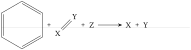
Example 1
\hreac

  \chemfig{*6(-=-=-=)}

  +

  \chemfig{X=[1]Y}

  +

  Z > X + Y

\endhreac