tkz-euclide
Intersections and angles
20 Angles
20.1 Definition and usage with tkz-euclide
In Euclidean geometry, an angle is the figure formed by two rays, called the sides of the angle, sharing a common endpoint, called the vertex of the angle [Wikipedia]. With tkz-euclide a ray is defined by two points, so an angle is defined by three points, as in \(\widehat{AOB}\); the vertex \(O\) is the second point. Their order matters, because the angle is assumed to be given counterclockwise. In trigonometry and mathematics in general, plane angles are conventionally measured counterclockwise, starting with \(0^\circ\) pointing directly to the right (or east), and \(90^\circ\) pointing straight up (or north) [Wikipedia]. Let us agree that an angle measured counterclockwise is positive.


Angles are involved in several macros, such as \tkzDefPoint, \tkzDefPointBy[rotation = …], \tkzDrawArc and \tkzGetAngle, described next. Except for the last one, all these macros accept negative angles.
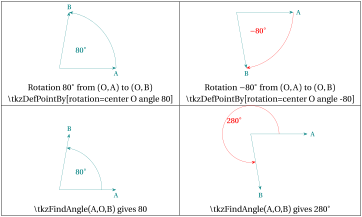
As we can see, the \(-80^\circ\) rotation defines a clockwise angle but the macro \tkzFindAngle recovers a counterclockwise angle.
20.2 Recovering an angle \tkzGetAngle
\tkzGetAngle(⟨name of macro⟩)
Assigns the value in degrees of an angle to a macro. The value is positive, between \(0^\circ\) and \(360^\circ\). This macro retrieves \tkzAngleResult and stores it in a new macro.
| arguments | example | explanation |
|---|---|---|
| name of macro | \tkzGetAngle{ang} | \ang contains the value of the angle. |
This auxiliary macro retrieves the result of the next macro, \tkzFindAngle.
20.3 Angle formed by three points
\tkzFindAngle(⟨pt1,pt2,pt3⟩)
The result is stored in a macro \tkzAngleResult.
| arguments | example | explanation |
|---|---|---|
| (pt1,pt2,pt3) | \tkzFindAngle(A,B,C) | \tkzAngleResult gives the angle (\(\overrightarrow{BA},\overrightarrow{BC}\)) |
The measure is always positive, between \(0^\circ\) and \(360^\circ\). With the usual conventions, a counterclockwise angle smaller than a straight angle always measures between \(0^\circ\) and \(180^\circ\), while a clockwise angle smaller than a straight angle measures more than \(180^\circ\). \tkzGetAngle retrieves the angle.
20.3.1 Verification of angle measurement
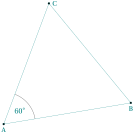
\begin{tikzpicture}[scale=.75]

  \tkzDefPoint(-1,1){A}

  \tkzDefPoint(5,2){B}

  \tkzDefEquilateral(A,B)

  \tkzGetPoint{C}

  \tkzDrawPolygon(A,B,C)

  \tkzFindAngle(B,A,C) \tkzGetAngle{angleBAC}

  \edef\angleBAC{\fpeval{round(\angleBAC)}}

  \tkzDrawPoints(A,B,C)

  \tkzLabelPoints(A,B)

  \tkzLabelPoint[right](C){$C$}

  \tkzLabelAngle(B,A,C){\angleBAC$^\circ$}

  \tkzMarkAngle[size=1.5](B,A,C)

\end{tikzpicture}
20.3.2 Determination of the three angles of a triangle
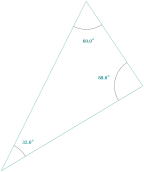
\begin{tikzpicture}

\tikzset{label angle style/.append style={pos=1.4}}

\tkzDefPoints{0/0/a,5/3/b,3/6/c}

\tkzDrawPolygon(a,b,c)

\tkzFindAngle(c,b,a)\tkzGetAngle{angleCBA}

\pgfmathparse{round(1+\angleCBA)}

\let\angleCBA\pgfmathresult

\tkzFindAngle(a,c,b)\tkzGetAngle{angleACB}

\pgfmathparse{round(\angleACB)}

\let\angleACB\pgfmathresult

\tkzFindAngle(b,a,c)\tkzGetAngle{angleBAC}

\pgfmathparse{round(\angleBAC)}

\let\angleBAC\pgfmathresult

\tkzMarkAngle(c,b,a)

\tkzLabelAngle(c,b,a){\tiny $\angleCBA^\circ$}

\tkzMarkAngle(a,c,b)

\tkzLabelAngle(a,c,b){\tiny $\angleACB^\circ$}

\tkzMarkAngle(b,a,c)

\tkzLabelAngle(b,a,c){\tiny $\angleBAC^\circ$}

\end{tikzpicture}
20.3.3 Angle between two circles
We look for the angle formed by the tangents at a point of intersection.
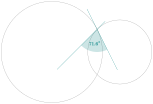
\begin{tikzpicture}[scale=.4]

\pgfkeys{/pgf/number format/.cd,%

          fixed,precision=1}

\tkzDefPoints{0/0/A,6/0/B,4/2/C}

\tkzDrawCircles(A,C B,C)

\tkzDefLine[tangent at=C](A) \tkzGetPoint{a}

\tkzDefPointsBy[symmetry = center C](a){d}

\tkzDefLine[tangent at=C](B) \tkzGetPoint{b}

\tkzDrawLines[add=1 and 4](a,C  C,b)

\tkzFillAngle[fill=teal,opacity=.2%

                        ,size=2](b,C,d)

\tkzFindAngle(b,C,d)\tkzGetAngle{bcd}

\tkzLabelAngle[pos=1.25](b,C,d){%

  \tiny $\pgfmathprintnumber{\bcd}^\circ$}

\end{tikzpicture}
20.4 Angle formed by a straight line with the horizontal axis \tkzFindSlopeAngle
More interesting than the previous one: the result is between \(-180^\circ\) and \(+180^\circ\).
\tkzFindSlopeAngle(⟨A,B⟩)
Determines the slope (as an angle) of the straight line \((AB)\). The result is stored in the macro \tkzAngleResult.
| arguments | example | explanation |
|---|---|---|
| (pt1,pt2) | \tkzFindSlopeAngle(A,B) |
\tkzGetAngle retrieves the result; if you don’t need to keep it, you can use \tkzAngleResult.
20.4.1 How to use \tkzFindSlopeAngle
Here \((AB)\) is the bisector of \(\widehat{CAD}\), and the slope of \((AD)\) is zero. We get the slope of \((AB)\), then rotate twice.
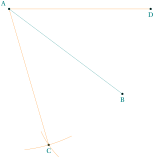
\begin{tikzpicture}

 \tkzDefPoint(1,5){A} \tkzDefPoint(5,2){B}

 \tkzFindSlopeAngle(A,B)\tkzGetAngle{tkzang}

 \tkzDefPointBy[rotation= center A angle \tkzang ](B)

 \tkzGetPoint{C}

 \tkzDefPointBy[rotation= center A angle -\tkzang ](B)

 \tkzGetPoint{D}

 \tkzDrawSegment(A,B)

 \tkzDrawSegments[new](A,C A,D)

 \tkzDrawPoints(A,B,C,D)

 \tkzCompass[length=1](A,C)

 \tkzCompass[delta=10,brown](B,C)

 \tkzLabelPoints(B,C,D)

 \tkzLabelPoints[above left](A)

\end{tikzpicture}
20.4.2 Use of \tkzFindSlopeAngle and \tkzGetAngle
Here is another construction of a perpendicular bisector (mediator).
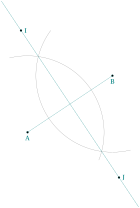
\begin{tikzpicture}

 \tkzInit

 \tkzDefPoint(0,0){A}        \tkzDefPoint(3,2){B}

 \tkzDefLine[mediator](A,B)  \tkzGetPoints{I}{J}

 \tkzCalcLength(A,B)         \tkzGetLength{dAB}

 \tkzFindSlopeAngle(A,B)     \tkzGetAngle{tkzangle}

 \begin{scope}[rotate=\tkzangle]

   \tkzSetUpArc[color=gray,line width=0.2pt,%

     /tkzcompass/delta=10]

   \tkzDrawArc[R,arc](B,3/4*\dAB)(120,240)

   \tkzDrawArc[R,arc](A,3/4*\dAB)(-45,60)

   \tkzDrawLine(I,J)         \tkzDrawSegment(A,B)

  \end{scope}

  \tkzDrawPoints(A,B,I,J)    \tkzLabelPoints(A,B)

   \tkzLabelPoints[right](I,J)

\end{tikzpicture}
20.4.3 Another use of \tkzFindSlopeAngle
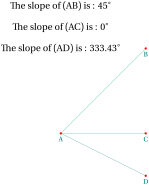
\begin{tikzpicture}[scale=1.5]

  \tkzDefPoint(1,2){A}    \tkzDefPoint(3,4){B}

  \tkzDefPoint(3,2){C}    \tkzDefPoint(3,1){D}

  \tkzDrawSegments(A,B A,C A,D)

  \tkzDrawPoints[color=red](A,B,C,D)

  \tkzLabelPoints(A,B,C,D)

  \tkzFindSlopeAngle(A,B)\tkzGetAngle{SAB}

  \tkzFindSlopeAngle(A,C)\tkzGetAngle{SAC}

  \tkzFindSlopeAngle(A,D)\tkzGetAngle{SAD}

  \pgfkeys{/pgf/number format/.cd,fixed,precision=2}

  \tkzText(1,5){The slope of (AB) is :

     $\pgfmathprintnumber{\SAB}^\circ$}

  \tkzText(1,4.5){The slope of (AC) is :

     $\pgfmathprintnumber{\SAC}^\circ$}

  \tkzText(1,4){The slope of (AD) is :

     $\pgfmathprintnumber{\SAD}^\circ$}

\end{tikzpicture}