tkz-euclide
Circles
17 Circles
Among the following macros, one draws a circle, which is not a real feat: you need the center of the circle and either its radius or a point of the circle. The most frequent use seemed to me to be a circle with a given center through a given point; this is the default, otherwise you use the option R. There are many special circles, for example the circumcircle of a triangle.
a first macro, \tkzDefCircle, gives the center and the radius (in cm) of a particular circle, which you retrieve with the macros \tkzGetPoint and \tkzGetLength;
a macro to draw a circle, \tkzDrawCircle;
a macro to color a disc without drawing the circle, \tkzFillCircle;
sometimes a drawing must be contained in a disc: this is the role of \tkzClipCircle;
finally, \tkzLabelCircle gives a label to a circle.
17.1 Characteristics of a circle: \tkzDefCircle
This macro gives the characteristics (center and radius) of some circles.
\tkzDefCircle[⟨local options⟩](⟨A,B⟩) or (⟨A,B,C⟩)
☞ 💣 Note that the arguments are lists of two or three points. The macro is used either with
\tkzGetPoints, to get the center and a point of the circle, or directly with
tkzFirstPointResult and tkzSecondPointResult if you don’t need to keep the results. \tkzGetLength gives the radius.
| arguments | example | explanation |
|---|---|---|
| (⟨pt1,pt2⟩) or (⟨pt1,pt2,pt3⟩) | (⟨A,B⟩) | \([AB]\) is radius \(A\) is the center |
| options | default | definition |
|---|---|---|
| R | circum | circle characterized by a center and a radius |
| diameter | circum | circle characterized by two points defining a diameter |
| circum | circum | circle circumscribed of a triangle |
| in | circum | incircle a triangle |
| ex | circum | excircle of a triangle |
| euler or nine | circum | Euler’s Circle |
| spieker | circum | Spieker Circle |
| apollonius | circum | circle of Apollonius |
| orthogonal from | circum | [orthogonal from = A ](O,M) |
| orthogonal through | circum | [orthogonal through = A and B](O,M) |
| K | 1 | coefficient used for a circle of Apollonius |
In the following examples, I draw the circles with a macro not yet presented. You may only need the center and a point of the circle.
17.1.1 Example with option R
With the macro \tkzGetPoint we get a point of the circle, its "east pole".
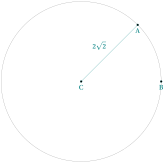
\begin{tikzpicture}[scale=1]

  \tkzDefPoint(3,3){C}

  \tkzDefPoint(5,5){A}

   \tkzCalcLength(A,C) \tkzGetLength{rAC}

  \tkzDefCircle[R](C,\rAC) \tkzGetPoint{B}

  \tkzDrawCircle(C,B)

  \tkzDrawSegment(C,A)

  \tkzLabelSegment[above left](C,A){$2\sqrt{2}$}

  \tkzDrawPoints(A,B,C)

  \tkzLabelPoints(A,C,B)

\end{tikzpicture}
17.1.2 Example with option diameter
It is simpler here to search directly for the midpoint of \([AB]\). The result is the center and if necessary

\begin{tikzpicture}

  \tkzDefPoint(0,0){O}

  \tkzDefPoint(2,2){B}

  \tkzDefCircle[diameter](O,B) \tkzGetPoint{A}

  \tkzDrawCircle(A,B)

  \tkzDrawPoints(O,A,B)

  \tkzDrawSegment(O,B)

  \tkzLabelPoints(O,A,B)

  \tkzLabelSegment[above left](O,A){$\sqrt{2}$}

  \tkzLabelSegment[above left](A,B){$\sqrt{2}$}

  \tkzMarkSegments[mark=s||](O,A A,B)

\end{tikzpicture}
17.1.3 Circles inscribed and circumscribed for a given triangle
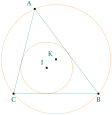
\begin{tikzpicture}[scale=.75]

 \tkzDefPoint(2,2){A}  \tkzDefPoint(5,-2){B}

 \tkzDefPoint(1,-2){C}

 \tkzDefCircle[in](A,B,C)

 \tkzGetPoints{I}{x}

 \tkzDefCircle[circum](A,B,C)

 \tkzGetPoint{K}

 \tkzDrawCircles[new](I,x K,A)

 \tkzLabelPoints[below](B,C)

 \tkzLabelPoints[above left](A,I,K)

 \tkzDrawPolygon(A,B,C)

 \tkzDrawPoints(A,B,C,I,K)

\end{tikzpicture}
17.1.4 Example with option ex
We want to define the excircle of a triangle opposite the vertex \(C\).
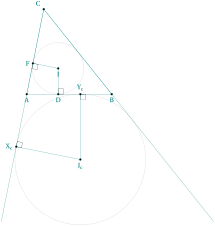
\begin{tikzpicture}[scale=.75]

  \tkzDefPoints{ 0/0/A,4/0/B,0.8/4/C}

  \tkzDefCircle[ex](B,C,A)

  \tkzGetPoints{J_c}{h}

  \tkzDefPointBy[projection=onto A--C ](J_c)

  \tkzGetPoint{X_c}

  \tkzDefPointBy[projection=onto A--B ](J_c)

  \tkzGetPoint{Y_c}

  \tkzDefCircle[in](A,B,C)

  \tkzGetPoints{I}{y}

  \tkzDrawCircles[color=lightgray](J_c,h I,y)

  \tkzDefPointBy[projection=onto A--C ](I)

  \tkzGetPoint{F}

  \tkzDefPointBy[projection=onto A--B ](I)

  \tkzGetPoint{D}

  \tkzDrawPolygon(A,B,C)

  \tkzDrawLines[add=0 and 1.5](C,A C,B)

  \tkzDrawSegments(J_c,X_c I,D  I,F J_c,Y_c)

  \tkzMarkRightAngles(A,F,I B,D,I J_c,X_c,A

     J_c,Y_c,B)

  \tkzDrawPoints(B,C,A,I,D,F,X_c,J_c,Y_c)

  \tkzLabelPoints(B,A,J_c,I,D)

  \tkzLabelPoints[above](Y_c)

  \tkzLabelPoints[left](X_c)

  \tkzLabelPoints[above left](C)

  \tkzLabelPoints[left](F)

\end{tikzpicture}
17.1.5 Euler’s circle for a given triangle with option euler
We verify that this circle passes through the midpoint of each side.
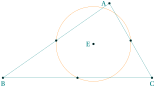
\begin{tikzpicture}[scale=.75]

   \tkzDefPoint(5,3.5){A}

   \tkzDefPoint(0,0){B} \tkzDefPoint(7,0){C}

   \tkzDefCircle[euler](A,B,C)

   \tkzGetPoints{E}{e}

   \tkzDefSpcTriangle[medial](A,B,C){M_a,M_b,M_c}

   \tkzDrawCircle[new](E,e)

   \tkzDrawPoints(A,B,C,E,M_a,M_b,M_c)

   \tkzDrawPolygon(A,B,C)

   \tkzLabelPoints[below](B,C)

   \tkzLabelPoints[left](A,E)

\end{tikzpicture}
17.1.6 Apollonius circles for a given segment: option apollonius
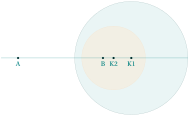
\begin{tikzpicture}[scale=0.75]

  \tkzDefPoint(0,0){A}

  \tkzDefPoint(4,0){B}

  \tkzDefCircle[apollonius,K=2](A,B)

  \tkzGetPoints{K1}{x}

  \tkzDrawCircle[color = teal!50!black,

      fill=teal!20,opacity=.4](K1,x)

  \tkzDefCircle[apollonius,K=3](A,B)

  \tkzGetPoints{K2}{y}

  \tkzDrawCircle[color=orange!50,

      fill=orange!20,opacity=.4](K2,y)

  \tkzLabelPoints[below](A,B,K1,K2)

  \tkzDrawPoints(A,B,K1,K2)

  \tkzDrawLine[add=.2 and 1](A,B)

\end{tikzpicture}
17.1.7 Excircles of a given triangle: option ex
You can also get the center and its projection on one side of the triangle
with \tkzGetFirstPoint{Jb} and \tkzGetSecondPoint{Tb}.
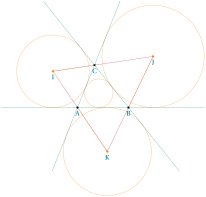
\begin{tikzpicture}[scale=.6]

  \tkzDefPoint(0,0){A}

  \tkzDefPoint(3,0){B}

  \tkzDefPoint(1,2.5){C}

  \tkzDefCircle[ex](A,B,C) \tkzGetPoints{I}{i}

  \tkzDefCircle[ex](C,A,B) \tkzGetPoints{J}{j}

  \tkzDefCircle[ex](B,C,A) \tkzGetPoints{K}{k}

  \tkzDefCircle[in](B,C,A) \tkzGetPoints{O}{o}

  \tkzDrawCircles[new](J,j I,i K,k O,o)

  \tkzDrawLines[add=1.5 and 1.5](A,B A,C B,C)

  \tkzDrawPolygon[purple](I,J,K)

  \tkzDrawSegments[new](A,K B,J C,I)

  \tkzDrawPoints(A,B,C)

  \tkzDrawPoints[new](I,J,K)

  \tkzLabelPoints(A,B,C,I,J,K)

\end{tikzpicture}
17.1.8 Spieker circle with option spieker
The incircle of the medial triangle \(M_aM_bM_c\) is the Spieker circle:
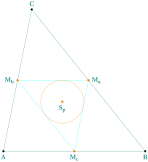
\begin{tikzpicture}[scale=1.25]

  \tkzDefPoints{ 0/0/A,4/0/B,0.8/4/C}

  \tkzDefSpcTriangle[medial](A,B,C){M_a,M_b,M_c}

  \tkzDefTriangleCenter[spieker](A,B,C)

  \tkzGetPoint{S_p}

  \tkzDrawPolygon(A,B,C)

  \tkzDrawPolygon[cyan](M_a,M_b,M_c)

  \tkzDrawPoints(B,C,A)

  \tkzDefCircle[spieker](A,B,C)

  \tkzDrawPoints[new](M_a,M_b,M_c,S_p)

  \tkzDrawCircle[new](tkzFirstPointResult,%

    tkzSecondPointResult)

  \tkzLabelPoints[right](M_a)

  \tkzLabelPoints[left](M_b)

  \tkzLabelPoints[below](A,B,M_c,S_p)

  \tkzLabelPoints[above](C)

\end{tikzpicture}
17.2 Projection of excenters
\tkzDefProjExcenter[⟨local options⟩](⟨A,B,C⟩)(⟨a,b,c⟩){⟨X,Y,Z⟩}
Each excenter has three projections on the sides of the triangle \(ABC\). We can get them all with one macro:
\tkzDefProjExcenter[name=J](A,B,C)(a,b,c){Y,Z,X}.
| options | default | definition |
|---|---|---|
| name | no defaut | used to name the vertices |
| arguments | default | definition |
|---|---|---|
| (pt1=\(\alpha_1\),pt2=\(\alpha_2\),…) | no default | Each point has a assigned weight |
17.2.1 Excircles
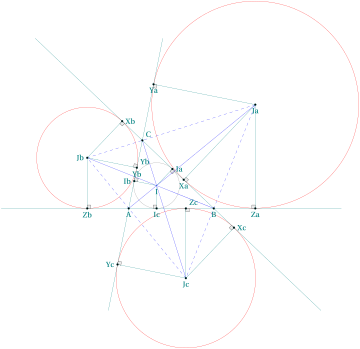
\begin{tikzpicture}[scale=.6]

\tikzset{line style/.append style={line width=.2pt}}

\tikzset{label style/.append style={color=teal,font=\footnotesize}}

\tkzDefPoints{0/0/A,5/0/B,0.8/4/C}

\tkzDefSpcTriangle[excentral,name=J](A,B,C){a,b,c}

\tkzDefSpcTriangle[intouch,name=I](A,B,C){a,b,c}

\tkzDefProjExcenter[name=J](A,B,C)(a,b,c){X,Y,Z}

\tkzDefCircle[in](A,B,C)   \tkzGetPoint{I} \tkzGetSecondPoint{T}

\tkzDrawCircles[red](Ja,Xa Jb,Yb Jc,Zc)

\tkzDrawCircle(I,T)

\tkzDrawPolygon[dashed,color=blue](Ja,Jb,Jc)

\tkzDrawLines[add=1.5 and 1.5](A,C A,B B,C)

\tkzDrawSegments(Ja,Xa Ja,Ya Ja,Za

                 Jb,Xb Jb,Yb Jb,Zb

                 Jc,Xc Jc,Yc Jc,Zc

                 I,Ia I,Ib I,Ic)

\tkzMarkRightAngles[size=.2,fill=gray!15](Ja,Za,B Ja,Xa,B Ja,Ya,C Jb,Yb,C)

\tkzMarkRightAngles[size=.2,fill=gray!15](Jb,Zb,B Jb,Xb,C Jc,Yc,A Jc,Zc,B)

\tkzMarkRightAngles[size=.2,fill=gray!15](Jc,Xc,C I,Ia,B I,Ib,C I,Ic,A)

\tkzDrawSegments[blue](Jc,C Ja,A Jb,B)

\tkzDrawPoints(A,B,C,Xa,Xb,Xc,Ja,Jb,Jc,Ia,Ib,Ic,Ya,Yb,Yc,Za,Zb,Zc)

\tkzLabelPoints(A,Ya,Yb,Ja,I)

\tkzLabelPoints[left](Jb,Ib,Yc)

\tkzLabelPoints[below](Zb,Ic,Jc,B,Za,Xa)

\tkzLabelPoints[above right](C,Zc,Yb)

\tkzLabelPoints[right](Xb,Ia,Xc)

\end{tikzpicture}
17.2.2 Orthogonal from
Circle with a given center, orthogonal to a given circle. \tkzGetPoints{z1}{z2} gives two points of the circle.
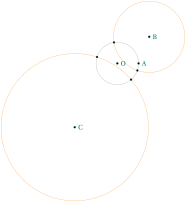
\begin{tikzpicture}[scale=.75]

  \tkzDefPoints{0/0/O,1/0/A}

  \tkzDefPoints{1.5/1.25/B,-2/-3/C}

  \tkzDefCircle[orthogonal from=B](O,A)

  \tkzGetPoints{z1}{z2}

  \tkzDefCircle[orthogonal from=C](O,A)

  \tkzGetPoints{t1}{t2}

  \tkzDrawCircle(O,A)

  \tkzDrawCircles[new](B,z1 C,t1)

  \tkzDrawPoints(t1,t2,C)

  \tkzDrawPoints(z1,z2,O,A,B)

  \tkzLabelPoints[right](O,A,B,C)

\end{tikzpicture}
17.2.3 Orthogonal through
Circle orthogonal to a given circle, through two given points.
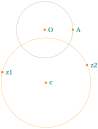
\begin{tikzpicture}[scale=1]

  \tkzDefPoint(0,0){O}

  \tkzDefPoint(1,0){A}

  \tkzDrawCircle(O,A)

  \tkzDefPoint(-1.5,-1.5){z1}

  \tkzDefPoint(1.5,-1.25){z2}

  \tkzDefCircle[orthogonal through=z1 and z2](O,A)

   \tkzGetPoint{c}

  \tkzDrawCircle[new](tkzPointResult,z1)

  \tkzDrawPoints[new](O,A,z1,z2,c)

  \tkzLabelPoints[right](O,A,z1,z2,c)

\end{tikzpicture}