tkz-euclide
Lines, triangles and polygons
15 Triangles
15.1 Definition of triangles \tkzDefTriangle
The following macros define or construct a triangle from at least two points.
The following triangles can be defined:
two angles determines a triangle with two angles;
equilateral determines an equilateral triangle;
isosceles right determines an isosceles right triangle;
half determines a right triangle whose legs (the two sides of the right angle) are in the ratio \(2\);
pythagore determines a right triangle whose sides are proportional to 3, 4 and 5;
school determines a right triangle whose angles are 30, 60 and 90 degrees;
golden (or sublime) determines the golden triangle: an isosceles triangle whose base is \([AB]\) and whose base angles are 72 degrees;
euclid determines Euclid’s triangle, which has the same angles but whose side is \([AB]\) (36 degrees at \(A\)); in previous versions the option was "euclide" with an "e";
gold determines a right triangle, with the right angle at \(B\), whose legs are in the ratio \(\Phi=1.618034\): \(AB/BC=\Phi\). This triangle comes from the golden rectangle.
cheops determines a third point such that the triangle is isosceles, with sides proportional to \(2\), \(\Phi\) and \(\Phi\).
\tkzDefTriangle[⟨local options⟩](⟨A,B⟩)
The order of the points matters, because the triangle is constructed counterclockwise. The macro is used either with \tkzGetPoint, or directly with tkzPointResult if you don’t need to keep the point.
| options | default | definition |
|---|---|---|
| two angles= #1 and #2 | no defaut | triangle knowing two angles |
| equilateral | equilateral | equilateral triangle |
| half | equilateral | B rectangle \(AB=2BC\) \(AC\) hypothenuse |
| isosceles right | equilateral | isosceles right triangle |
| pythagore | equilateral | proportional to the pythagorean triangle 3-4-5 |
| pythagoras | equilateral | same as above |
| egyptian | equilateral | same as above |
| school | equilateral | angles of 30, 60 and 90 degrees |
| gold | equilateral | B rectangle and \(AB/AC = \Phi\) |
| euclid | equilateral | angles of 72, 72 and 36 degrees, \(A\) is the apex |
| golden | equilateral | angles of 72, 72 and 36 degrees, \(C\) is the apex |
| sublime | equilateral | angles of 72, 72 and 36 degrees, \(C\) is the apex |
| cheops | equilateral | AC=BC, AC and BC are proportional to \(2\) and \(\Phi\). |
| swap | false | gives the symmetric point with respect to \(AB\) |
\tkzGetPoint stores the point; otherwise tkzPointResult can be used immediately.
15.1.1 Option equilateral
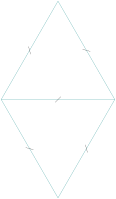
\begin{tikzpicture}

  \tkzDefPoint(0,0){A}

  \tkzDefPoint(4,0){B}

  \tkzDefTriangle[equilateral](A,B)

  \tkzGetPoint{C}

  \tkzDrawPolygons(A,B,C)

  \tkzDefTriangle[equilateral](B,A)

  \tkzGetPoint{D}

  \tkzDrawPolygon(B,A,D)

  \tkzMarkSegments[mark=s|](A,B B,C A,C A,D B,D)

\end{tikzpicture}
15.1.2 Option two angles
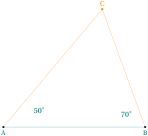
\begin{tikzpicture}

\tkzDefPoint(0,0){A}

\tkzDefPoint(5,0){B}

\tkzDefTriangle[two angles = 50 and 70](A,B)

\tkzGetPoint{C}

\tkzDrawSegment(A,B)

\tkzDrawPoints(A,B)

\tkzLabelPoints(A,B)

\tkzDrawSegments[new](A,C B,C)

\tkzDrawPoints[new](C)

\tkzLabelPoints[above,new](C)

\tkzLabelAngle[pos=1.4](B,A,C){$50^\circ$}

\tkzLabelAngle[pos=0.8](C,B,A){$70^\circ$}

\end{tikzpicture}
15.1.3 Option school
The angles are 30, 60 and 90 degrees.
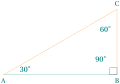
\begin{tikzpicture}

  \tkzDefPoints{0/0/A,4/0/B}

  \tkzDefTriangle[school](A,B)

  \tkzGetPoint{C}

  \tkzMarkRightAngles(C,B,A)

  \tkzLabelAngle[pos=0.8](B,A,C){$30^\circ$}

  \tkzLabelAngle[pos=0.8](C,B,A){$90^\circ$}

  \tkzLabelAngle[pos=0.8](A,C,B){$60^\circ$}

  \tkzDrawSegments(A,B)

  \tkzDrawSegments[new](A,C B,C)

  \tkzLabelPoints(A,B)

  \tkzLabelPoints[above](C)

\end{tikzpicture}
15.1.4 Option pythagore
This triangle has sides whose lengths are proportional to 3, 4 and 5.

\begin{tikzpicture}

  \tkzDefPoints{0/0/A,4/0/B}

  \tkzDefTriangle[pythagore](A,B)

  \tkzGetPoint{C}

  \tkzDrawSegments(A,B)

  \tkzDrawSegments[new](A,C B,C)

  \tkzMarkRightAngles(A,B,C)

  \tkzDrawPoints[new](C)

  \tkzDrawPoints(A,B)

  \tkzLabelPoints[above](A,B)

  \tkzLabelPoints[new](C)

\end{tikzpicture}
15.1.5 Option pythagore and swap
This triangle has sides whose lengths are proportional to 3, 4 and 5.
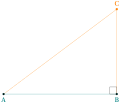
\begin{tikzpicture}

  \tkzDefPoints{0/0/A,4/0/B}

  \tkzDefTriangle[pythagore,swap](A,B)

  \tkzGetPoint{C}

  \tkzDrawSegments(A,B)

  \tkzDrawSegments[new](A,C B,C)

  \tkzMarkRightAngles(A,B,C)

  \tkzLabelPoint[above,new](C){$C$}

  \tkzDrawPoints[new](C)

  \tkzDrawPoints(A,B)

  \tkzLabelPoints(A,B)

\end{tikzpicture}
15.1.6 Option golden
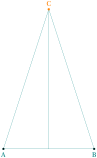
\begin{tikzpicture}[scale=.8]

\tkzDefPoint(0,0){A} \tkzDefPoint(4,0){B}

\tkzDefTriangle[golden](A,B)\tkzGetPoint{C}

\tkzDefSpcTriangle[in,name=M](A,B,C){a,b,c}

\tkzDrawPolygon(A,B,C)

\tkzDrawPoints(A,B)

\tkzDrawSegment(C,Mc)

\tkzDrawPoints[new](C)

\tkzLabelPoints(A,B)

\tkzLabelPoints[above,new](C)

\end{tikzpicture}
15.1.7 Option euclid
The euclid and golden triangles have the same shape, but the segment \([AB]\) is a side in the first one and the base in the second one.

\begin{tikzpicture}[scale=.75]

 \tkzDefPoint(0,0){A} \tkzDefPoint(4,0){B}

 \tkzDefTriangle[euclid](A,B)\tkzGetPoint{C}

 \tkzDrawPolygon(A,B,C)

 \tkzDrawPoints(A,B,C)

 \tkzLabelPoints(C)

 \tkzLabelPoints[above](A,B)

 \tkzLabelAngle[pos=0.8](A,B,C){$72^\circ$}

 \tkzLabelAngle[pos=0.8](B,C,A){$72^\circ$}

 \tkzLabelAngle[pos=0.8](C,A,B){$36^\circ$}

\end{tikzpicture}
15.1.8 Option isosceles right
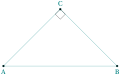
\begin{tikzpicture}

  \tkzDefPoint(0,0){A}

  \tkzDefPoint(4,0){B}

  \tkzDefTriangle[isosceles right](A,B)

  \tkzGetPoint{C}

  \tkzDrawPolygons(A,B,C)

  \tkzDrawPoints(A,B,C)

  \tkzMarkRightAngles(A,C,B)

  \tkzLabelPoints(A,B)

  \tkzLabelPoints[above](C)

\end{tikzpicture}
15.1.9 Option gold
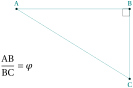
\begin{tikzpicture}

 \tkzDefPoints{0/0/A,4/0/B}

 \tkzDefTriangle[gold](A,B)

 \tkzGetPoint{C}

 \tkzDrawPolygon(A,B,C)

 \tkzDrawPoints(A,B,C)

 \tkzLabelPoints[above](A,B)

 \tkzLabelPoints[below](C)

 \tkzMarkRightAngle(A,B,C)

 \tkzText(0,-2){$\dfrac{AB}{BC}=\varphi$}

\end{tikzpicture}
15.2 Specific triangles with \tkzDefSpcTriangle
The centers of some triangles have been defined in the section on special points; here we determine the three vertices of specific triangles.
\tkzDefSpcTriangle[⟨local options⟩](⟨p1,p2,p3⟩){⟨r1,r2,r3⟩}
The order of the points is important! p1p2p3 defines a triangle; the result is a triangle whose vertices have as references name followed by r1, r2 and r3. If name is empty, the references are r1, r2 and r3.
| options | default | definition |
|---|---|---|
| orthic | centroid | determined by endpoints of the altitudes ... |
| centroid or medial | centroid | intersection of the triangle’s three triangle medians |
| in or incentral | centroid | determined with the angle bisectors |
| ex or excentral | centroid | determined with the excenters |
| extouch | centroid | formed by the points of tangency with the excircles |
| intouch or contact | centroid | formed by the points of tangency of the incircle |
| each of the vertices | ||
| euler | centroid | formed by Euler points on the nine-point circle |
| symmedial | centroid | intersection points of the symmedians |
| tangential | centroid | formed by the lines tangent to the circumcircle |
| feuerbach | centroid | formed by the points of tangency of the nine-point ... |
| circle with the excircles | ||
| name | empty | used to name the vertices |
15.2.1 How to name the vertices
With \tkzDefSpcTriangle[medial,name=M](A,B,C){_A,_B,_C} you get three vertices named \(M_A\), \(M_B\) and \(M_C\).
With \tkzDefSpcTriangle[medial](A,B,C){a,b,c} you get three vertices named \(a\), \(b\) and \(c\).
With \tkzDefSpcTriangle[medial,name=M_](A,B,C){A,B,C} you also get three vertices named \(M_A\), \(M_B\) and \(M_C\).
15.2.2 Option medial or centroid
The centroid of a triangle is the point \(G\) (sometimes also denoted \(M\)) where the three medians of the triangle meet; it is therefore sometimes called the median point. The centroid always lies inside the triangle.
Weisstein, Eric W. "Centroid triangle" From MathWorld–A Wolfram Web Resource.
In the following example, we get the Euler circle, which passes through the points defined above.
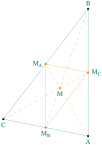
  \begin{tikzpicture}[rotate=90,scale=.75]

   \tkzDefPoints{0/0/A,6/0/B,0.8/4/C}

   \tkzDefTriangleCenter[centroid](A,B,C)

   \tkzGetPoint{M}

   \tkzDefSpcTriangle[medial,name=M](A,B,C){_A,_B,_C}

   \tkzDrawPolygon(A,B,C)

   \tkzDrawSegments[dashed,new](A,M_A B,M_B C,M_C)

   \tkzDrawPolygon[new](M_A,M_B,M_C)

   \tkzDrawPoints(A,B,C)

   \tkzDrawPoints[new](M,M_A,M_B,M_C)

   \tkzLabelPoints[above](B)

   \tkzLabelPoints[below](A,C,M_B)

   \tkzLabelPoints[right](M_C)

   \tkzLabelPoints[left](M_A)

   \tkzLabelPoints[font=\scriptsize](M)

  \end{tikzpicture}
15.2.3 Option in or incentral
The incentral triangle is the triangle whose vertices are determined by the intersections of the reference triangle’s angle bisectors with the respective opposite sides.
Weisstein, Eric W. "Incentral triangle" From MathWorld–A Wolfram Web Resource.
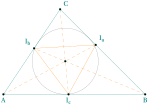
\begin{tikzpicture}[scale=1]

  \tkzDefPoints{ 0/0/A,5/0/B,2/3/C}

  \tkzDefSpcTriangle[in,name=I](A,B,C){_a,_b,_c}

  \tkzDefCircle[in](A,B,C) \tkzGetPoints{I}{a}

  \tkzDrawCircle(I,a)

  \tkzDrawPolygon(A,B,C)

  \tkzDrawPolygon[new](I_a,I_b,I_c)

  \tkzDrawSegments[dashed,new](A,I_a B,I_b C,I_c)

  \tkzDrawPoints(A,B,C,I,I_a,I_b,I_c)

  \tkzLabelPoints[below](A,B,I_c)

  \tkzLabelPoints[above left](I_b)

  \tkzLabelPoints[above right](C,I_a)

\end{tikzpicture}
15.2.4 Option ex or excentral
The excentral triangle of a triangle \(ABC\) is the triangle \(J_aJ_bJ_c\) with vertices corresponding to the excenters of \(ABC\).
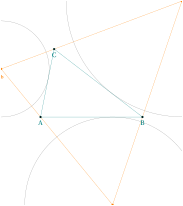
\begin{tikzpicture}[scale=.6]

 \tkzDefPoints{0/0/A,6/0/B,0.8/4/C}

 \tkzDefSpcTriangle[excentral,name=J](A,B,C){_a,_b,_c}

 \tkzDefSpcTriangle[extouch,name=T](A,B,C){_a,_b,_c}

 \tkzDrawPolygon(A,B,C)

 \tkzDrawPolygon[new](J_a,J_b,J_c)

 \tkzClipBB

 \tkzDrawPoints(A,B,C)

 \tkzDrawPoints[new](J_a,J_b,J_c)

 \tkzLabelPoints(A,B,C)

 \tkzLabelPoints[new](J_b,J_c)

 \tkzLabelPoints[new,above](J_a)

 \tkzDrawCircles[gray](J_a,T_a J_b,T_b J_c,T_c)

\end{tikzpicture}
15.2.5 Option intouch or contact
The contact triangle of a triangle \(ABC\), also called the intouch triangle, is the triangle formed by the points of tangency of the incircle of \(ABC\) with its sides.
Weisstein, Eric W. "Contact triangle" From MathWorld–A Wolfram Web Resource.
We get the points where the incircle touches the sides.
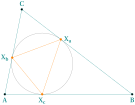
\begin{tikzpicture}[scale=.75]

 \tkzDefPoints{0/0/A,6/0/B,0.8/4/C}

 \tkzDefSpcTriangle[intouch,name=X](A,B,C){_a,_b,_c}

 \tkzInCenter(A,B,C)\tkzGetPoint{I}

 \tkzDefCircle[in](A,B,C) \tkzGetPoints{I}{i}

 \tkzDrawCircle(I,i)

 \tkzDrawPolygon(A,B,C)

 \tkzDrawPolygon[new](X_a,X_b,X_c)

 \tkzDrawPoints(A,B,C)

 \tkzDrawPoints[new](X_a,X_b,X_c)

 \tkzLabelPoints[right](X_a)

 \tkzLabelPoints[left](X_b)

 \tkzLabelPoints[above](C)

 \tkzLabelPoints[below](A,B,X_c)

\end{tikzpicture}
15.2.6 Option extouch
The extouch triangle \(T_aT_bT_c\) is the triangle formed by the points of tangency of the sides of a triangle \(ABC\) with its excircles, with centers \(J_a\), \(J_b\) and \(J_c\). The points \(T_a\), \(T_b\) and \(T_c\) can also be constructed as the points which bisect the perimeter of \(ABC\) starting at \(A\), \(B\) and \(C\).
Weisstein, Eric W. "Extouch triangle" From MathWorld–A Wolfram Web Resource.
We get the points of contact of the excircles, and the triangle formed by the centers of the excircles.
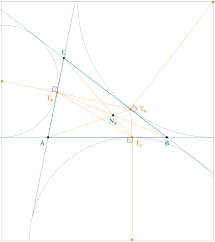
\begin{tikzpicture}[scale=.7]

\tkzDefPoints{0/0/A,6/0/B,0.8/4/C}

\tkzDefSpcTriangle[excentral,

                 name=J](A,B,C){_a,_b,_c}

\tkzDefSpcTriangle[extouch,

                  name=T](A,B,C){_a,_b,_c}

\tkzDefTriangleCenter[nagel](A,B,C)

\tkzGetPoint{N_a}

\tkzDefTriangleCenter[centroid](A,B,C)

\tkzGetPoint{G}

\tkzDrawPoints[new](J_a,J_b,J_c)

\tkzClipBB \tkzShowBB

\tkzDrawCircles[gray](J_a,T_a J_b,T_b J_c,T_c)

\tkzDrawLines[add=1 and 1](A,B B,C C,A)

\tkzDrawSegments[new](A,T_a B,T_b C,T_c)

\tkzDrawSegments[new](J_a,T_a J_b,T_b J_c,T_c)

\tkzDrawPolygon(A,B,C)

\tkzDrawPolygon[new](T_a,T_b,T_c)

\tkzDrawPoints(A,B,C,N_a)

\tkzDrawPoints[new](T_a,T_b,T_c)

\tkzLabelPoints[below left](A)

\tkzLabelPoints[below](N_a,B)

\tkzLabelPoints[above](C)

\tkzLabelPoints[new,below left](T_b)

\tkzLabelPoints[new,below right](T_c)

\tkzLabelPoints[new,right=6pt](T_a)

\tkzMarkRightAngles[fill=gray!15](J_a,T_a,B

 J_b,T_b,C J_c,T_c,A)

\end{tikzpicture}
15.2.7 Option orthic
Given a triangle \(ABC\), the triangle \(H_AH_BH_C\) whose vertices are endpoints of the altitudes from each of the vertices of ABC is called the orthic triangle, or sometimes the altitude triangle. The three lines \(AH_A\), \(BH_B\) and \(CH_C\) are concurrent at the orthocenter \(H\) of \(ABC\).
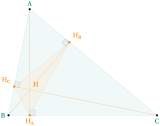
\begin{tikzpicture}[scale=.75]

\tkzDefPoints{1/5/A,0/0/B,7/0/C}

 \tkzDefSpcTriangle[orthic](A,B,C){H_A,H_B,H_C}

 \tkzDefTriangleCenter[ortho](B,C,A)

 \tkzGetPoint{H}

 \tkzDefPointWith[orthogonal,normed](H_A,B)

 \tkzGetPoint{a}

 \tkzDrawSegments[new](A,H_A B,H_B C,H_C)

 \tkzMarkRightAngles[fill=gray!20,

         opacity=.5](A,H_A,C B,H_B,A C,H_C,A)

 \tkzDrawPolygon[fill=teal!20,opacity=.3](A,B,C)

 \tkzDrawPoints(A,B,C)

 \tkzDrawPoints[new](H_A,H_B,H_C)

 \tkzDrawPolygon[new,fill=orange!20,

                opacity=.3](H_A,H_B,H_C)

 \tkzLabelPoints(C)

 \tkzLabelPoints[left](B)

 \tkzLabelPoints[above](A)

 \tkzLabelPoints[new](H_A)

 \tkzLabelPoints[new,above left](H_C)

 \tkzLabelPoints[new,above right](H_B,H)

\end{tikzpicture}
15.2.8 Option feuerbach
The Feuerbach triangle is the triangle formed by the three points of tangency of the nine-point circle with the excircles.
Weisstein, Eric W. "Feuerbach triangle" From MathWorld–A Wolfram Web Resource.
The points of tangency define the Feuerbach triangle.
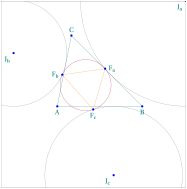
\begin{tikzpicture}[scale=1]

  \tkzDefPoint(0,0){A}

  \tkzDefPoint(3,0){B}

  \tkzDefPoint(0.5,2.5){C}

  \tkzDefCircle[euler](A,B,C) \tkzGetPoint{N}

  \tkzDefSpcTriangle[feuerbach,

                       name=F](A,B,C){_a,_b,_c}

  \tkzDefSpcTriangle[excentral,

                       name=J](A,B,C){_a,_b,_c}

  \tkzDefSpcTriangle[extouch,

                        name=T](A,B,C){_a,_b,_c}

  \tkzLabelPoints[below left](J_a,J_b,J_c)

  \tkzClipBB \tkzShowBB

  \tkzDrawCircle[purple](N,F_a)

  \tkzDrawPolygon(A,B,C)

  \tkzDrawPolygon[new](F_a,F_b,F_c)

  \tkzDrawCircles[gray](J_a,F_a J_b,F_b J_c,F_c)

  \tkzDrawPoints[blue](J_a,J_b,J_c,%

          F_a,F_b,F_c,A,B,C)

  \tkzLabelPoints(A,B,F_c)

  \tkzLabelPoints[above](C)

  \tkzLabelPoints[right](F_a)

  \tkzLabelPoints[left](F_b)

\end{tikzpicture}
15.2.9 Option tangential
The tangential triangle is the triangle \(T_aT_bT_c\) formed by the lines tangent to the circumcircle of a given triangle \(ABC\) at its vertices. It is therefore the antipedal triangle of \(ABC\) with respect to the circumcenter \(O\).
Weisstein, Eric W. "Tangential Triangle." From MathWorld–A Wolfram Web Resource.
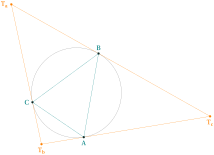
\begin{tikzpicture}[scale=.5,rotate=80]

  \tkzDefPoints{0/0/A,6/0/B,1.8/4/C}

  \tkzDefSpcTriangle[tangential,

    name=T](A,B,C){_a,_b,_c}

  \tkzDrawPolygon(A,B,C)

  \tkzDrawPolygon[new](T_a,T_b,T_c)

  \tkzDrawPoints(A,B,C)

  \tkzDrawPoints[new](T_a,T_b,T_c)

  \tkzDefCircle[circum](A,B,C)

  \tkzGetPoint{O}

  \tkzDrawCircle(O,A)

  \tkzLabelPoints(A)

  \tkzLabelPoints[above](B)

  \tkzLabelPoints[left](C)

  \tkzLabelPoints[new](T_b,T_c)

  \tkzLabelPoints[new,left](T_a)

\end{tikzpicture}
15.2.10 Option euler
The Euler triangle of a triangle \(ABC\) is the triangle \(E_AE_BE_C\) whose vertices are the midpoints of the segments joining the orthocenter \(H\) with the respective vertices. The vertices of the triangle are known as the Euler points, and lie on the nine-point circle.
Weisstein, Eric W. "Euler Triangle." From MathWorld–A Wolfram Web Resource.
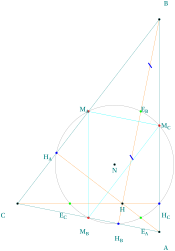
\begin{tikzpicture}[rotate=90,scale=1.25]

 \tkzDefPoints{0/0/A,6/0/B,0.8/4/C}

 \tkzDefSpcTriangle[medial,

     name=M](A,B,C){_A,_B,_C}

 \tkzDefTriangleCenter[euler](A,B,C)

     \tkzGetPoint{N} % I= N nine points

 \tkzDefTriangleCenter[ortho](A,B,C)

        \tkzGetPoint{H}

 \tkzDefMidPoint(A,H) \tkzGetPoint{E_A}

 \tkzDefMidPoint(C,H) \tkzGetPoint{E_C}

 \tkzDefMidPoint(B,H) \tkzGetPoint{E_B}

 \tkzDefSpcTriangle[ortho,name=H](A,B,C){_A,_B,_C}

 \tkzDrawPolygon(A,B,C)

 \tkzDrawCircle(N,E_A)

 \tkzDrawSegments[new](A,H_A B,H_B C,H_C)

 \tkzDrawPoints(A,B,C,N,H)

 \tkzDrawPoints[red](M_A,M_B,M_C)

 \tkzDrawPoints[blue]( H_A,H_B,H_C)

 \tkzDrawPoints[green](E_A,E_B,E_C)

 \tkzAutoLabelPoints[center=N,font=\scriptsize]%

(A,B,C,M_A,M_B,M_C,H_A,H_B,H_C,E_A,E_B,E_C)

\tkzLabelPoints[font=\scriptsize](H,N)

\tkzMarkSegments[mark=s|,size=3pt,

  color=blue,line width=1pt](B,E_B E_B,H)

   \tkzDrawPolygon[color=cyan](M_A,M_B,M_C)

\end{tikzpicture}
15.2.11 Option euler and Option orthic
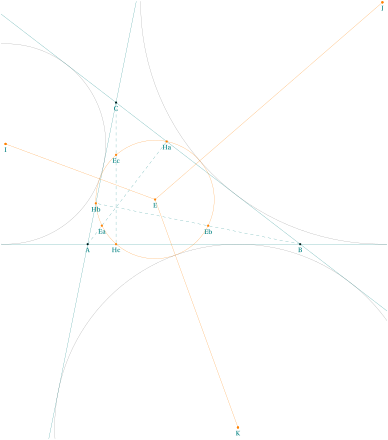
  \begin{tikzpicture}[scale=1.25]

    \tkzDefPoints{0/0/A,6/0/B,0.8/4/C}

    \tkzDefSpcTriangle[euler,name=E](A,B,C){a,b,c}

    \tkzDefSpcTriangle[orthic,name=H](A,B,C){a,b,c}

    \tkzDefExCircle(A,B,C) \tkzGetPoints{I}{i}

    \tkzDefExCircle(C,A,B) \tkzGetPoints{J}{j}

    \tkzDefExCircle(B,C,A) \tkzGetPoints{K}{k}

    \tkzDrawPoints[orange](I,J,K)

    \tkzLabelPoints[font=\scriptsize](A,B,C,I,J,K)

    \tkzClipBB

    \tkzInterLC(I,C)(I,i) \tkzGetSecondPoint{Fc}

    \tkzInterLC(J,B)(J,j) \tkzGetSecondPoint{Fb}

    \tkzInterLC(K,A)(K,k) \tkzGetSecondPoint{Fa}

    \tkzDrawLines[add=1.5 and 1.5](A,B A,C B,C)

    \tkzDefCircle[euler](A,B,C) \tkzGetPoints{E}{e}

    \tkzDrawCircle[orange](E,e)

    \tkzDrawSegments[orange](E,I E,J E,K)

    \tkzDrawSegments[dashed](A,Ha B,Hb C,Hc)

    \tkzDrawCircles(J,j I,i K,k)

    \tkzDrawPoints(A,B,C)

    \tkzDrawPoints[orange](E,I,J,K,Ha,Hb,Hc,Ea,Eb,Ec,Fa,Fb,Fc)

    \tkzLabelPoints[font=\scriptsize](E,Ea,Eb,Ec,Ha,Hb,Hc,Fa,Fb,Fc)

  \end{tikzpicture}
15.2.12 Option symmedial
The symmedial triangle \(K_AK_BK_C\) is the triangle whose vertices are the intersection points of the symmedians with the reference triangle \(ABC\).
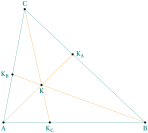
\begin{tikzpicture}

\tkzDefPoint(0,0){A}

\tkzDefPoint(5,0){B}

\tkzDefPoint(.75,4){C}

\tkzDefTriangleCenter[symmedian](A,B,C)\tkzGetPoint{K}

\tkzDefSpcTriangle[symmedial,name=K_](A,B,C){A,B,C}

\tkzDrawPolygon(A,B,C)

\tkzDrawSegments[new](A,K_A B,K_B C,K_C)

\tkzDrawPoints(A,B,C,K,K_A,K_B,K_C)

\tkzLabelPoints(A,B,K,K_C)

\tkzLabelPoints[above](C)

\tkzLabelPoints[right](K_A)

\tkzLabelPoints[left](K_B)

\end{tikzpicture}
15.3 Permutation of two points of a triangle
\tkzPermute(⟨\(pt1\),\(pt2\),\(pt3\)⟩)
| arguments | example | explanation |
|---|---|---|
| (pt1,pt2,pt3) | \tkzPermute(A,B,C) | \(A\) and \(\widehat{B,A,C}\) unchanged, \(B\) and \(C\) exchanged |
The triangle is unchanged.
15.3.1 Modification of the school triangle
This triangle is constructed from the segment \([AB]\) on the ray \([Ax)\).
If we want the segment \([AC]\) to be on \([Ax)\), we just have to swap \(B\) and \(C\).
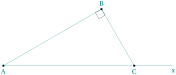
\begin{tikzpicture}

  \tkzDefPoints{0/0/A,4/0/B,6/0/x}

  \tkzDefTriangle[school](A,B)

  \tkzGetPoint{C}

  \tkzPermute(A,B,C)

  \tkzDrawSegments(A,B C,x)

  \tkzDrawSegments(A,C B,C)

  \tkzDrawPoints(A,B,C)

  \tkzLabelPoints(A,C,x)

  \tkzLabelPoints[above](B)

  \tkzMarkRightAngles(C,B,A)

\end{tikzpicture}
Remark: only the first point is unchanged. The order of the last two arguments does not matter.